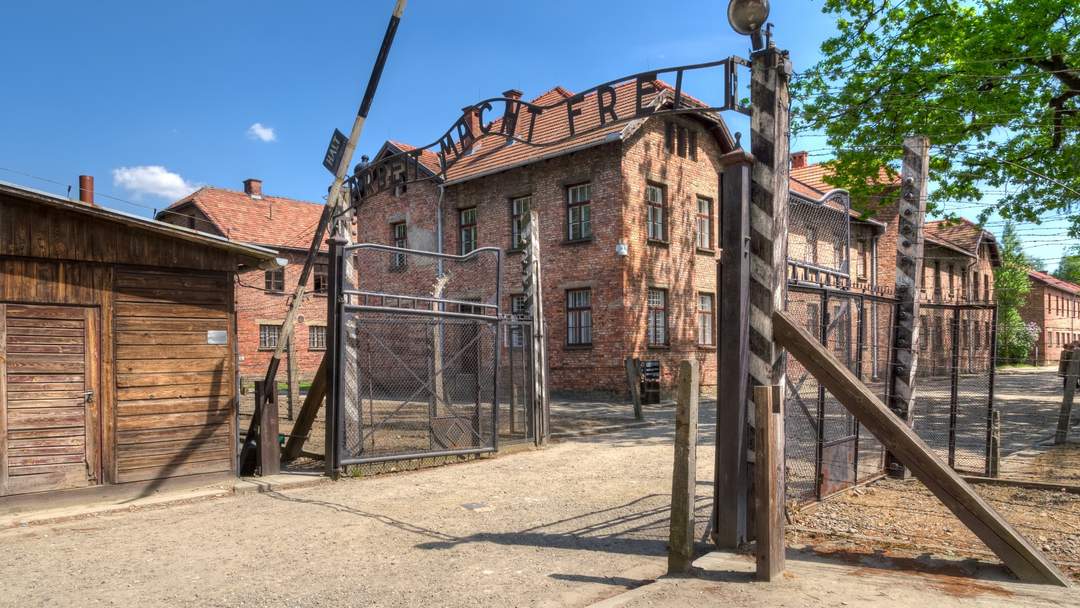
Eagle Pharmacy in Krakow: A Quiet Witness to the Ghetto
June 5, 2026
Visit Eagle Pharmacy in Krakow and learn the story of Tadeusz Pankiewicz, the pharmacist who remained inside the Krakow Ghetto.
June 5, 2026
The Pharmacy That Stayed Open Inside the Ghetto
At first glance, the building at 18 Ghetto Heroes Square in Krakow does not look dramatic. It is modest, almost easy to pass by. No high tower, no monumental façade, no obvious sign that history changed shape here.
And yet this small corner building in Podgórze was once one of the most important addresses inside the Krakow Ghetto.
During the German occupation, it housed the Eagle Pharmacy - Apteka pod Orłem - run by Tadeusz Pankiewicz. When the Nazis created the ghetto in this part of the city, most non-Jewish residents and business owners were forced to leave. Pankiewicz stayed. His pharmacy became the only pharmacy operating inside the ghetto, and he became a rare non-Jewish witness to daily life, fear, deportations and acts of quiet resistance.
Today, the former pharmacy is a museum. But its story is not only about one building or one man. It is about what happens when an ordinary place becomes a point of contact between two worlds: the world outside the ghetto walls and the world of people trapped inside them.
Before the War: an Ordinary Pharmacy in Podgórze
Before the Second World War, Podgórze was a busy urban district on the southern side of the Vistula River. The Eagle Pharmacy served local residents much like any neighbourhood pharmacy. People came in for medicines, advice, small everyday purchases and conversation. Jewish and Polish customers used the same counter, entered through the same door and stood in the same queue.
The pharmacy had been connected with the Pankiewicz family since the early 20th century. Tadeusz Pankiewicz, trained as a pharmacist, took over its management in the 1930s. Nothing in the pre-war rhythm of the place suggested that it would soon stand inside one of the most tragic zones of occupied Krakow.
That is one of the reasons the story is so powerful. The Eagle Pharmacy was not designed as a place of heroism. It became one because history closed in around it.
The Krakow Ghetto and the Changing Meaning of Plac Zgody
In March 1941, the German occupiers established the Krakow Ghetto in Podgórze, not in Kazimierz, the traditional Jewish district of the city. Thousands of Jewish residents were forced into a small, overcrowded area, separated from the rest of Krakow by walls, gates and constant surveillance.
You can read more historical background about the Krakow Ghetto and its place in the wartime history of the city.
The pharmacy stood at Plac Zgody, now known as Ghetto Heroes Square. During the ghetto period, this square became one of the most painful sites in occupied Krakow. It was a place of orders, selections, waiting and deportations. People gathered there with bundles, suitcases, coats, documents and children. Some were sent to forced labour. Others were deported to death camps.
From the windows of the pharmacy, Pankiewicz and his staff could see what was happening. This detail matters. Much of the history of the Eagle Pharmacy is based on proximity - on the fact that the pharmacy was not somewhere near the ghetto, but inside it, facing the square where crucial events unfolded.
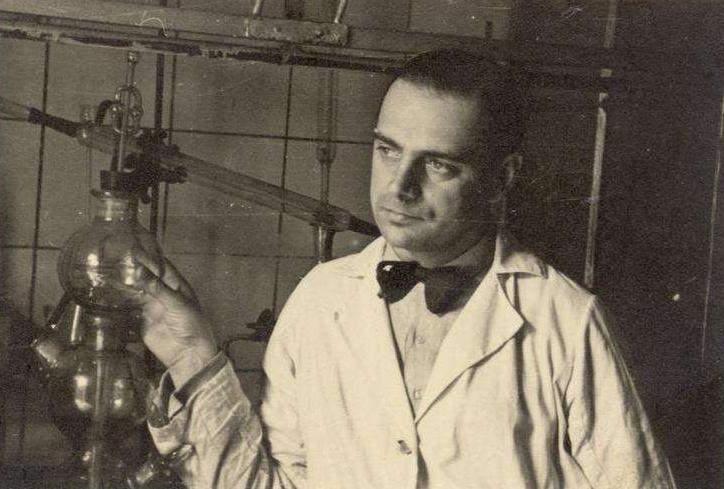
Portrait of Tadeusz Pankiewicz standing in the back room of his pharmacy during World War II, surrounded by shelves with medicines and pharmacy equipment. Public domain.
Tadeusz Pankiewicz: Pharmacist, Witness, Helper
Tadeusz Pankiewicz did not act like a fictional hero. His story is quieter, more human and, in many ways, more convincing because of that. He remained a pharmacist, but under conditions in which even the simplest professional duties became morally charged.
The pharmacy supplied medicines, but it also offered something less visible: contact, information, temporary safety and a point of normality in a place designed to strip people of normal life. Accounts connected with Pankiewicz describe help given through medicine, messages, practical support and human presence.
The pharmacy was also a place where people could meet discreetly. In the ghetto, where movement was controlled and trust could become a matter of survival, such a place had enormous value. It was a room with shelves and bottles, but also a rare space where someone from outside the Jewish community remained present, attentive and willing to help.
Pankiewicz later wrote about his wartime experiences in his memoir The Pharmacy in the Krakow Ghetto. His testimony is important not only because it records events, but because it preserves the texture of daily life: fear, exhaustion, sudden violence, rumours, hope, despair and the strange persistence of ordinary gestures in extraordinary circumstances.
The Women Behind the Pharmacy Counter
The story of the Eagle Pharmacy should not be reduced only to Pankiewicz. The museum exhibition also remembers the women who worked with him: Irena Droździkowska, Aurelia Danek-Czortowa and Helena Krywaniuk.
This is important because wartime help often depended on networks, routines and repeated small actions rather than one single dramatic moment. A pharmacy could not function through symbolic courage alone. It needed people to open doors, prepare medicines, pass information, observe danger and keep going despite fear.
Their presence helps us see the pharmacy not as a legend, but as a working place under extreme pressure.
Why a Pharmacy Mattered So Much
A pharmacy inside a ghetto had obvious practical value. Medicines were scarce. Illness spread easily in overcrowded conditions. Hunger, stress and poor sanitation weakened people. But the Eagle Pharmacy was more than a medical point.
In wartime conditions, small things could become decisive. A sedative, a dressing, a document hidden for a moment, a message passed discreetly, a warning, a place to step inside and breathe. These actions did not stop the machinery of persecution, but they mattered to individual people.
This is where the story becomes especially moving. The help offered at the Eagle Pharmacy was often not spectacular. It was precise, practical and human. It answered immediate needs. And in the reality of the ghetto, immediate needs could become matters of life and death.
Avoid the queues and visit the original Schindler’s Factory Museum – one of Krakow’s most important historical sites.With this fast-track ticket, you’ll explore the powerful permanent exhibition Krakow under Nazi Occupation 1939–1945, located in the real factory where Oskar Schindler worked.Discover original rooms, multimedia installations, and the story behind Schindler’s List – all at your own pace.
Get your Wieliczka Salt Mine tickets in advance and skip the ticket office queues. This entry ticket with guided tour guarantees access to one of Poland’s most iconic UNESCO World Heritage Sites, with a local expert leading you through 2.5 km of underground chambers, tunnels and chapels – including the stunning Chapel of St. Kinga. Choose your language, select your tour date and preferred time, and enjoy a seamless experience without the stress of same-day availability or long lines.
Book online now to guarantee your entry to this unforgettable underground experience in Poland.
Duration: 3hLive guideSkip-theLineTransportation included
Explore Krakow in a fast, comfortable, and eco-friendly way with a Krakow City Tour by electric golf cart. This sightseeing tour is a great introduction to the city, especially for first-time visitors or travellers with limited time who want to see the highlights without long walks.
During the ride, you will explore key areas of Krakow, including the Old Town surroundings, Kazimierz – the historic Jewish district, and parts of Podgórze, where the famous Schindler’s Factory was located. A professionally prepared audio guide provides historical context and helps you understand the city’s past and character.
This electric car tour allows you to see more in less time while staying comfortable in all weather conditions, making it an easy and practical way to start exploring Krakow.
Duration: 1h - 2hAudio GuideTransportation included
Walk in the footsteps of history on a professionally guided visit to Auschwitz-Birkenau – one of the most important memorial sites in the world. Departing from Krakow, this all-inclusive tour offers powerful insight, respectful reflection, and seamless logistics, so you can focus on what truly matters. Led by a licensed guide, you'll visit both Auschwitz I and Auschwitz II-Birkenau and return with a deeper understanding of the past. Whether travelling solo or with others, this tour is trusted by thousands every year for its emotional impact and flawless organisation.
Duration: 7hLive guideSkip-theLineTransportation included
The history of the Eagle Pharmacy cannot be separated from the destruction of the Krakow Ghetto. Deportations from the ghetto took place in 1942, and the final liquidation followed in March 1943. People were murdered on the spot, transferred to the Plaszow forced labour camp or deported to Auschwitz-Birkenau.
The pharmacy stood through these events as a witness. That word is sometimes overused in historical writing, but here it is accurate. Pankiewicz did not only hear about the terror later. He saw it from the place where he worked.
This gives the museum its particular emotional weight. Visitors are not entering a reconstructed historical idea. They are entering rooms where someone watched the collapse of an entire community.
Visiting the Eagle Pharmacy Today
Today, the Eagle Pharmacy is a branch of the Museum of Krakow. The exhibition is arranged in the rooms of the former pharmacy and uses the original function of those spaces to tell a wider story of the ghetto, Pankiewicz and the people connected with the site.
It is not a large museum, but it is one of the most meaningful places in Podgórze. Its strength lies in scale. You do not need vast halls to understand the weight of this story. A counter, shelves, photographs, documents and personal testimony are enough.
The museum also works well as part of a wider route through wartime Krakow. Nearby, visitors can see Ghetto Heroes Square, fragments of the former ghetto wall and other sites connected with the history of Jewish Krakow under German occupation.
How the Eagle Pharmacy Connects with Schindler’s Factory
The Eagle Pharmacy and Schindler’s Factory tell different parts of the same wartime landscape.
The pharmacy brings visitors into the daily reality of the Krakow Ghetto. Schindler’s Factory broadens the perspective, showing occupied Krakow, German policy, forced labour, terror, survival and the complex story of Oskar Schindler’s enamelware factory.
Taken together, these sites help you see that wartime Krakow was not one story, but many overlapping stories: occupation, persecution, forced labour, rescue, survival and memory.
Why This Place Stays With You
The Eagle Pharmacy is not overwhelming because of size. It is overwhelming because of contrast.
A pharmacy is associated with care, remedies and routine. The ghetto was a place of deprivation, fear and planned destruction. The collision of these meanings makes Apteka pod Orłem so powerful.
It reminds us that history is not only made in offices, military headquarters or battlefields. Sometimes it is made behind a pharmacy counter, in whispered conversations, in a bottle of medicine handed over quietly, in the decision to stay when leaving would have been easier.
For visitors interested in Krakow’s wartime history, the Eagle Pharmacy is one of the places that should not be missed. It does not offer a simple story. It offers something more valuable: a close, human perspective on a city under occupation and on people who tried to preserve dignity when the world around them was being deliberately dismantled.
Continue Exploring Wartime Krakow
To understand this part of Krakow more deeply, it is worth combining a visit to the Eagle Pharmacy with Schindler’s Factory and the former ghetto area in Podgórze.
If you would like to learn this history with expert commentary and a clearer sense of context, you can join our Schindler’s Factory guided tour. It is a thoughtful way to explore the wartime history of Krakow, connect individual stories with the wider occupation period and better understand the places that still shape the city’s memory today.
Fakty historyczne o lokalizacji muzeum, wystawie, Tadeuszu Pankiewiczu i pracownicach apteki oparłam na materiałach Muzeum Krakowa. Informacje o utworzeniu getta w Podgórzu oraz jego likwidacji w marcu 1943 roku zweryfikowałam z materiałami United States Holocaust Memorial Museum
Explore Krakow in a fast, comfortable, and eco-friendly way with a Krakow City Tour by electric golf cart. This sightseeing tour is a great introduction to the city, especially for first-time visitors or travellers with limited time who want to see the highlights without long walks.
During the ride, you will explore key areas of Krakow, including the Old Town surroundings, Kazimierz – the historic Jewish district, and parts of Podgórze, where the famous Schindler’s Factory was located. A professionally prepared audio guide provides historical context and helps you understand the city’s past and character.
This electric car tour allows you to see more in less time while staying comfortable in all weather conditions, making it an easy and practical way to start exploring Krakow.
Duration: 1h - 2hAudio GuideTransportation included
Avoid the queues and visit the original Schindler’s Factory Museum – one of Krakow’s most important historical sites.With this fast-track ticket, you’ll explore the powerful permanent exhibition Krakow under Nazi Occupation 1939–1945, located in the real factory where Oskar Schindler worked.Discover original rooms, multimedia installations, and the story behind Schindler’s List – all at your own pace.
Step inside Oskar Schindler’s Enamel Factory in Krakow and explore the city’s history during World War II on a guided visit with a licensed guide. During the tour, you will learn about everyday life in occupied Krakow, the tragedy of the Krakow Ghetto, and the true story of a man who saved more than a thousand lives. The presence of a guide allows you to immerse yourself more deeply in the exhibition and better understand the broader historical context and the human stories behind the events.
Duration: 2hLive guideSkip-theLineTransportation included
















 Duration: 2h
 Skip-theLine
 Transportation included
 Live guide